When deciding on your Singapore A-Level subjects, one crucial question arises: should you take H1 or H2 Biology? This decision significantly impacts your academic journey and future prospects.

Statistics on H2 Biology Student Subject Combinations
Before diving deeper, let’s examine some general statistics. Based on my H2 Biology tuition experience, here are common subject combination patterns among students:
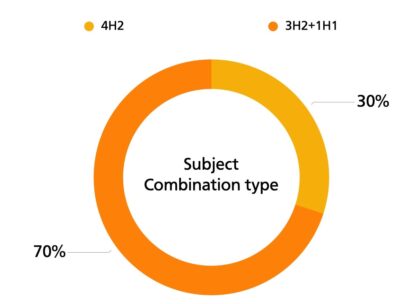
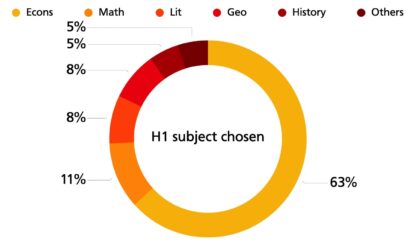
These statistics provide insight into popular subject pairings among H2 Biology students.
H1 vs H2 Biology: Key Difference
In simplistic terms, H1 or H2 subjects differ significantly in their coverage.
Where, H2 subjects covers far more content even though the difficulty is the same across H1 or H2 biology.
H1 vs H2 Biology: Considerations for Arts and Science Stream Students
Choosing between H1 and H2 Biology depends on your stream and academic goals. For Arts students who are ambitious and also interested in Biology, especially those taking Geography, H2 Biology is ideal.
This is because there are significant overlaps between the H2 Biology and Geography syllabi, particularly in climate change, introduced in 2017.
For those who are less ambitious then you can choose H1 instead. Especially those who have interest in exploring biology without committing to the H2 level. Unfortunately, H1 has little overlaps with Geography. Especially since climate change is not in the H1 syllabi.
For Science students passionate about Biology, H2 Biology is the better choice. It meets the minimum three H2 subject requirement and also serves as an alternative to Physics.
However, a small number of Science students opt for H1 Biology, usually due to struggling with the subject or having a poor school learning environment.
The key difference lies in curriculum coverage. H1 Biology has limited coverage, potentially leading to patchy understanding and lack of depth.
In contrast, H2 Biology provides comprehensive coverage, offering in-depth knowledge and broader perspectives. In addition, if you also take H1 geography, there will be knowledge overlaps as well as a lighter academic load.
For instance, in diversity and evolution, H1 Biology covers environmental factors influencing natural selection but lacks explanation of speciation mechanisms and the environmental role in species diversification.

As an H2 Biology tutor, I believe enjoying and also scoring well in H2 biology is possible. See my past students Nicholas Chan and Zi Ting as examples.
H1 or H2 biology (content coverage)
There is indeed significant reduction in H1 biology content in comparison to H2.
This can be an advantage, especially considering JC life is hectic. This allows students to allocate more time to their remaining H2 subjects.
In terms of the syllabus structure, there are 4 cores in H2 biology (the cells and biomolecules of life | Genetics and Inheritance | Energy and equilibrium | Biological evolution) and 2 extension topics (Infectious diseases | climate change).
Conversely, H1 Biology reduces learning outcomes across each core.
Notably, all mentions of microorganisms (bacteria and viruses) and molecular techniques are omitted. Additionally, Infectious Diseases as an extension topic is excluded.
These areas are particularly interesting and relevant especially considering current global health concerns. And is also the topics which my students asks me the most questions during class leading to intense discussions and satisfaction with the subject coverage.

As such this is also extends across to relevant fields of study in relevant medical and biomedical courses. Universities will also look at your grades in H2 biology highly to ascertain your eligibility as well as potential placement.
Exams format differences
The best part about H1 biology is the exams!
Whilst the H2 biology exam is comprehensive (paper 1/2/3+5), H1 biology exams comprises only P1 and 2.
P1 comprises MCQs whilst P2 comprises structure and essay questions.
This format is more reminiscent of the old format of H2 biology P2 prior to 2017.
Since there are no long stimulus questions and integrative style essay questions of P3 in the H2 biology syllabus, this is a big relief to exam taking students since they are comparatively harder.
Dropping H2 Biology to H1: A Strategic Decision?
Many students assume that dropping to H1 Biology means an easier life due to reduced coverage.
However, some will realize to their horror afterwards that they need to spend far more effort than anticipated. Especially those in J2 who are considering dropping their H2 Biology to H1.
This is because, these students who eventually decide to drop the subject to H1 from a 4 H2 subject combination do so from a poor foundation.

When attempting H1 exams, many continue to find difficulty in exam questions. The reason being, the foundation topics contribute the core ideas where questions come from. Poor foundation means that one can continue to score badly even at the H1 level.
Instead of thinking dropping to H1 biology for ‘easier life’, think what one do to built a firmer foundation. That way, you will can play around with whichever H1/2 combination to give you the highest rank points and hence the highest number of eligible courses available for enrollment.
A note about using biology as a contrasting subject from 2026
Those who are opting to go into JC from 2024 will not have to contend with the contrasting subject at their A level exams in 2026.
This means that students who use biology as a contrasting subject in the past will not need to do so in the exam year 2026 onwards.

However, you may still want to opt for biology even if you are in the art stream, especially if you are also doing Geography. As I talked about it earlier, there are a lot of overlaps. In addition, the exam skillsets are also transferable between the 2 subjects. i.e. learn once use it in both subjects.
Although in my experience, students do H2 for one of the 2 subjects and the other as a H1.
That aside, the importance of a H1 or 4th H2 subject is minimized as well from 2026 onwards.
This is because, the new computation for rank points will ignore the H1 subject or 4th H2 UNLESS it improves it in tandem with H1 mother tongue language.
Bottomline
In conclusion, selecting H1 or H2 Biology for Singapore A-Levels requires careful consideration.
By selecting the right option, you’ll unlock a deeper understanding of biological concepts, enhance your analytical skills, and boost your academic confidence. H2 Biology provides comprehensive coverage, ideal for biomedical sciences, medicine, and life sciences aspirants.
Conversely, H1 Biology offers flexibility and foundational knowledge, or those seeking a broader subject combination.
Make an informed decision and maximize your Biology potential. Choose the path that propels you toward academic excellence, career opportunities, and a deeper understanding of the biological world.

I hope this detailed analysis has provided clarity. Best wishes for exam success and your future academic pursuits!
Read my other posts
- Best A level biology tuition in Singapore [Checklist]
- 1-1 or group tuition classes? [Question]
- Integrated Programme: Why Elite Schools are just better